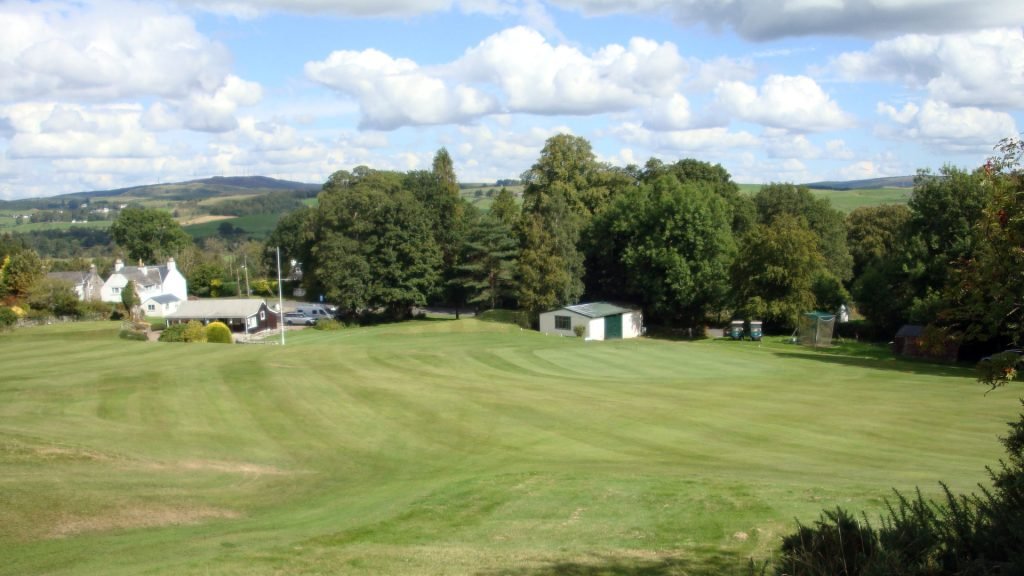
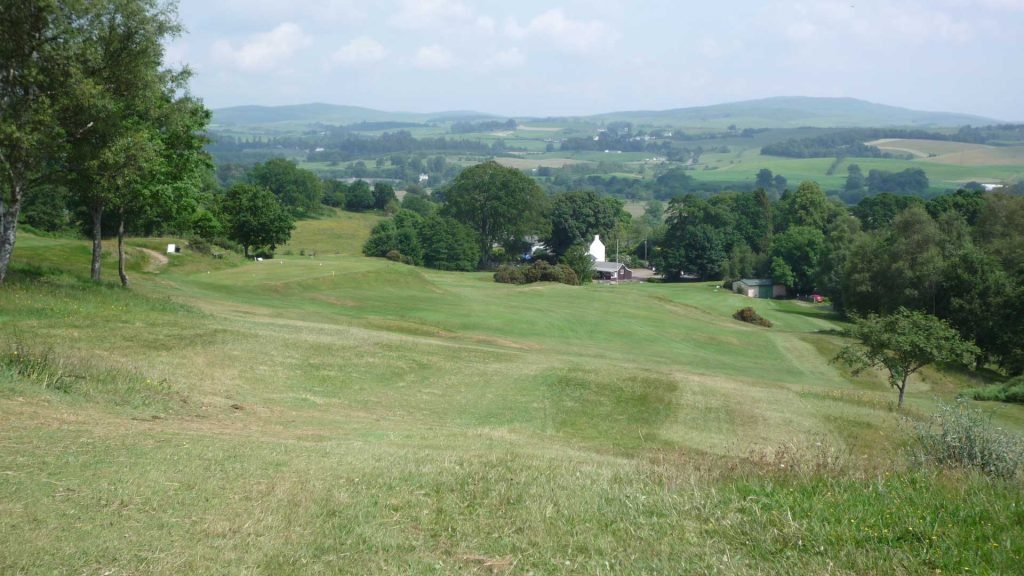
It is a 9 hole course. The yardage is 2270 from the yellow and ladies tees and 2503 from the white competition tees The course drains exceptionally well although in recent years it has suffered from increased rainfall which has necessitated additional drainage works. The course climbs from a woodland setting at the clubhouse over the first two holes to a more open and level terrain. Once the initial climb is over the going is easy with a variety of natural hazards providing interest and a test for the golfer. Golfers enjoy views of the Galloway hills, the Rhinns o’ Kells, the River Ken below and south over Loch Ken to the Solway Coast and Lake District in Cumbria. In quiet periods, golfers may elect to play 15 holes round the top by going from the 8th green to the 3rd tee. This eliminates going down the hill and back again. The winter league is played in this fashion. The par for 18 holes is 68 and the standard scratch score 67. The course record is 64 .
The First hole, Quarry Knowe, is an exceptionally difficult starting hole for gents. It is an uphill par 3, 216 yards long. It presents an uphill drive that only the longest hitters can reach the small sloping green. The ladies benefit from an extra shot as it is a par of 4. All have to contend with the sloping green. Those facing a downhill putt are likely see their ball disappear off the bottom of the green.
First Fairway 1
First Medal Tee
First Tee
First Green
First Fairway
Second Hole
The Second - Stey Brae - Par 4 - S.I. 13
The Second hole, Stey Brae, is a short uphill par 4. From the tee aim to the left of the marker pole to avoid the whinns on the right hand side. The green comes into view at the marker pole where the course plateau is reached. A good short iron into the green presents a birdie opportunity.
Second tee
Second Green
Second Green 1
Second fairway
Second Fairway 1
Third Hole
The Third - Rhinns o'Kells - Par 4 - S.I. 4
The Third hole is named Rhinns o’Kells after the range of Galloway Hills. The tee shot from the back tee needs to cross over a dry stane dyke (wall) made more difficult when playing into the wind. The tee shot from the forward tee calls for a decision to play safely short or to go for a long drive up the left-hand side. The green slopes towards the back of the green and from right to left giving a difficult mid iron shot over the marker pole on the hillock in front of the green. It is better to play slightly left to leave a chip to run up the slope of the green.
Third Tee
Third Sign
Third Green
Third Green Flag
Third From Tee
Third Fairway
Third Fairway 1
Third Approach
Third Approach 1
Fourth Hole
The Fourth - De'il's Ain - Par 3 - S.I. 17
The Fourth hole, De’il’s Ain, (the devil’s own) is aptly named. For most players the tee shot holds the green only in damp conditions. In dry weather, a wee tap is required to land short on the slope taking the ball down to the green. In dry conditions, play to the left where the slope is shallower. Balls are more likely to stop on this side. A good chip is often called for the player to secure par.
Fourth View
Fourth Tee
Fourth Tee 1
Fourth Green
Fourth Green 1
Fourth Fairway
Fifth Hole
The Fifth - Hole in Wa' - Par 4 - S.I. 8
The Fifth, Hole in Wa’ is the best hole on the course. The hole is a dog leg to the right from the back tees. The tee shot needs to cross the stane dyke, the dyke with the hole in it.. The second shot from the fairway requires the player to avoid the rough hill 20 yards short of the green on the left. The green is protected on the right side by a low mound immediately in front of the green. A shot played too long will find the whinns on the mound at the back of the green. An excellent par 4.
Fifth Tee
Fifth Tee 2
Fifth Tee 1
Fifth Green
Fifth Green 3
Fifth Green 2
Fifth Green 1
Fifth Fairway
Fifth Fairway 1
Fifth Approach
Sixth Hole
The Sixth - The Firs - Par 4 - S.I. 12
The Firs. A fine view over Loch Ken and beyond to Screel Hill may be seen from the tee. Long hitters may drive the green. Most players play safe to the fairway leaving a short, but accurate, approach shot into the saucer shaped green protected in front by a hillock covered with two clumps of whinns. Putts can be tricky. It may be seen as a short and simple hole but it can lure the unwary golfer into bogey.
Sixth Green
Sixth Fairway
Sixth-View
Seventh Hole
The Seventh - Spion Cop - Par 3 - S.I. 16
The par 3 Seventh, Spion Cop, is our signature hole. It needs a lofted club from the tee to reach the elevated green. Aim towards the left hand side of the green as balls tend to roll down to the right. There is more space to the left than it appears from the tee. Some of the borrows on this green are very subtle.
Seventh Tee
Seventh Green
Seventh Green 1
Seventh in winter
Loch Ben
Seventh Green
Flag on Seventh Green
Eighth Hole
The Eighth - Lang Knowe - Par 4 - S.I. 1
The Eight, Lang Knowe, is the hardest hole according to the stroke index but some say the third is harder. Surprisingly, it is only 367 yards from the medal tee, a par 4 for the gents and a par 5 for ladies. Trees line the view from an elevated tee to a rocky bank crossing the fairway. Gentlemen golfers have to carry this bank onto the fairway that slopes to the right towards the ninth tee. This reduces the run of the ball taking a sliced ball towards trouble. Ladies and elderly gents may lay up to the front of the bank. The second shot requires a medium to long iron shot. Add 2 clubs to your club selection to reach the raised green. The marker pole is at the back of the green.
Eighth Green
Eighth Fairway 2
Eighth View
Eighth Fairway
Eighth Fairway 3
Eighth Fairway 2
Eighth Fairway 1
Ninth Hole
The Ninth - Ken View - Par 4 - S.I. 9
The Ninth, Ken View, is downhill from the tee all the way to the clubhouse. The player may either play to the level area next to the second tee or go for a longer drive that risks ending upon the bank covered in semi rough. Long hitters may go for the green. Ally Neil holed his tee shot in 1997. The green slopes away from the player whose second shot is best pitched short and left to roll down the green, preferably finishing below the hole for an uphill putt.